The Challenge of Cell Segmentation in Spatially Resolved Transcriptomics
June 8, 2026·,,,,,,,,,,,, ,,,,,,,,,·
0 min read
,,,,,,,,,·
0 min read
Naveed Ishaque*
Peter Kharchenko*
Daria Lazic*
Jieran Sun*
Jean Yee Hwa Yang*
Martin Emons
Florian Heyl
Wolfgang Huber
Daniel Jones
Louis B Kuemmerle
Alex R Lederer
Malte D Luecken
Vinicius Maracaja-Coutinho
Matthias Meyer-Bender
Andrew Moorman
Evan W Newell
Quan Nguyen
Shyam Prabhakar
John Randell
Daria Romanovskaia
Oliver Stegle
Gary D Bader
Raphael Gottardo
Abstract
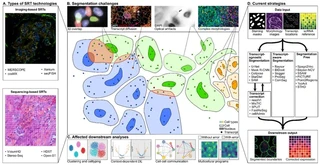
Spatially resolved transcriptomics (SRT) is transforming how we study tissues by measuring gene expression in cells in their spatial context. However, the field lacks robust methodological guidance on one of its most fundamental analytical steps: how to accurately segment cells and assign spatially localized transcripts to them. Major technical challenges include sparse molecular signals, transcript displacement, complex cellular morphologies, and the projection of three-dimensional tissue architecture onto two-dimensional imaging planes. These challenges make segmentation a major source of uncertainty, with errors that can propagate through downstream analyses and ultimately lead to misleading biological interpretations. Here, we argue that segmentation should be treated as a central unresolved problem in spatial omics rather than a routine preprocessing step. We review current approaches, highlight key methodological limitations, including the lack of appropriate metrics and gold-standard benchmarks, and propose a community-driven path forward. Establishing shared evaluation frameworks, scalable benchmark datasets, and transparent reporting standards will be essential for transforming SRT into a robust and reproducible foundation for biological discovery and clinical translation.
Type
Publication
bioRxiv
Authors
Authors
Authors
Authors
Authors
Authors
Authors
Authors
Authors
Authors
Authors
Authors
Authors

Authors
Matthias Meyer-Bender
(he/him)
Bioinformatician
I am a PhD candidate at the European Molecular Biology Laboratory (EMBL) in the group of Wolfgang Huber. My current work focuses on developing open-source software for the processing and analysis of large-scale spatial omics datasets (spatialproteomics, SegTraQ). I am passionate about applying computational methods, including machine learning and AI, to answer questions of biomedical relevance. Previously, I studied bioinformatics at the Technical University of Munich (TUM) and Ludwig Maximilian University of Munich (LMU). I also contribute to open-source projects such as scverse.
Authors
Authors
Authors
Authors
Authors
Authors
Authors
Authors
Authors